

We strategically covered two topics together, as many client conversations explore both these equity solutions side by side to determine the most cost-effective best fit.
While they seem an unlikely pair, Bridge Loans and Reverse for Purchase Loans draw the attention of both equity-rich home buyers AND their financial advisors.
Why? They conserve cash in a move and often provide the tool that makes the right home within reach.
Reducing out-of-pocket cash is always a win. Pair that with avoiding taxable withdrawals and eliminating mandatory mortgage payments-now that gets people’s attention.
If you or someone you know feels stuck, we may have a fix.
Bridge Loans
Challenge:
Homeowner does not want the stress of timing the sale of current home with the purchase of the next, but needs the equity as a down payment or payment in full. While pulling from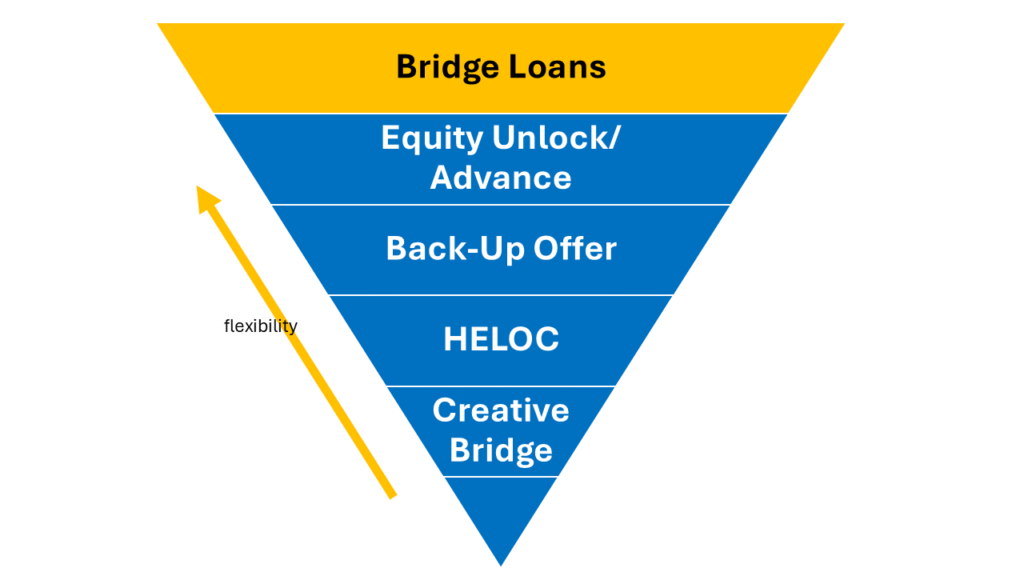 invested savings to ease the transition was reviewed, the tax consequences made that an expensive choice.
Solution:
A Bridge Loan. It’s actually a category, not a single loan. We shared the various combinations, timeframes, and associated costs. All you need to know-they can be customized to meet each client’s needs.
Outcome:
The once stuck, reluctant-to-move homeowner can purchase, move, tidy, stage, and sell. Brilliant!
Reverse For Purchase
Challenge:
Lois and Bruce sold their home and left Oregon in 2017. Their proceeds were just enough to cover the entire cost of the perfect retirement in Arizona. Fast forward to 2025; it turns out the very warm climate and 55+ community were not their dream. The new dream, return to Oregon.
In their absence, Oregon home prices had escalated, a lot. They returned with $250,000. Short of the required funds to pay cash for a home. 
Solution:
Reverse for Purchase. It too is a category of loan, not a single product. They chose one with a line of credit, landed a $300,000 condo they love, spending only $200,000 of their allotted budget. The shortfall was covered with a payment-optional reverse mortgage. If they choose to make payments, those payments reduce the loan balance AND activate the line-of-credit feature. They can draw from that line for as long as they live in their home, also payment- optional.
Outcome:
The right home, payment-optional, back in Oregon.
For more on the topics we covered, check out the links below
Reverse for Purchase Home Buyer’s Guide
Reverse Guidebook for Real Estate Professionals
Question of the Day
A great question on HELOC vs. Reverse. Why not get a HELOC instead of a reverse mortgage if a line of credit is the end goal?
Short answer: in the absence of a clear plan to pay them off, they often don’t end well. When used in a crisis or to cover ongoing expenses, that mandatory payment can become part of the very problem it was trying to solve.
Here’s a recent blog post on that very topic, sharing a recent client story.
Take the Quiz
We opened with a few fun facts as a quiz. Below are the answers with a short explanation.
Your home is safe from foreclosure if you don’t have a mortgage – False.
- Non-payment of property taxes will trigger foreclosure with or without a mortgage
A Bridge loan lets you transition between homes, resulting in no mortgage loan on your new home – False.
- Bridge financing is a temporary loan or commitment to ease the transition from a current home to the next one and pairs alongside a traditional home loan.
- Bridge loans cannot currently be paired with reverse mortgages, though rumblings of an option are in the works.
- There are equity advance options, often called bridge financing, that provide deferred payment access to equity with no accompanying purchase. Fairway does not offer this type of loan.
A Home Equity Line of Credit is the safest, cheapest access to equity – It Depends
- A HELOC has low upfront costs but requires payments. It depends on what constitutes cheap. Closing costs or ongoing payments. The Home Equity Conversion Mortgage line of credit is the alternative, offering a lower interest rate and optional payments.
A Reverse Mortgage takes the equity from your home, and you no longer own your home-False.
- Borrowers retain full title and may sell at any time. No bank owns the home.
- The equity is not taken; it is made available for the home to use, as needed.
A Side Note to Financial Advisors
A special note to those who may read this who work with retirement planning or retirees. These are the go-to loans for these homeowners. If you’re looking to minimize disruption to invested assets or add home equity to the mix to manage sequence-of-returns risk, we’re happy to share more about how these work.


